Showing posts with label fashion. Show all posts

Wednesday, June 30, 2010

METAL MAGAZINE: Issue 20 Cover Editorial


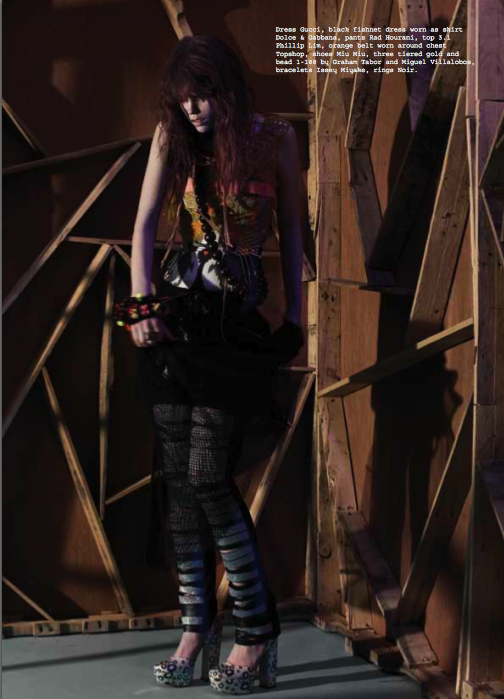
METAL's 4th Anniversary Issue is about to hit newsstands in the U.S., check out the cover editorial featuring model Meghan Collison, in which I assisted Senior Editor and stylist Angela Esteban Librero.

Photographer: San Sierra
Art direction: San Sierra & Cesar León
Stylist: Angela Esteban Librero
Make up: Chiho Omae using Sephora
Hair: Shinichi Arima
Production: Cesar León
Set design: Heather Feather,
Courtnay Saunders and Suzanne Arrow
Photography assistant: Manfredi Giaccochini
Stylist assistants: Carolyn Brennan,
Kei Furuichi & Abdoul Diallo
Lighting assistant: Mathew Margolin
Production assistant: Diego Aguirre
Model: Meghan Collison @ Next


Wednesday, January 20, 2010

Wanted Magazine: Graham Tabor


“It’s always very important that whatever you’re working on feels modern, even if you’re working with an archaic technique,” remarks New York-based knitwear designer Graham Tabor. “Like macramé, for instance, which has been around for thousands of years. The challenge is how you’re able to take that technique and reinterpret it to make it exciting and new– and something that’s appropriate for now.”

There is a quality of organized chaos to Graham Tabor’s sophisticated designs. With his layers of deconstructed translucent fabrics, perforated wool knits, torn stitching and fantastically distorted facial masks made in collaboration with Kristen Barron, Tabor’s overall vision is an archetype of the primitive merging with the futuristic.

The designer has been developing his innovative tailoring techniques for the past ten years, and is currently making a name for himself as a forerunner in a skill that has remained largely untouched by American designers. “Knits are a very marketable commodity in New York,” says Tabor. “There aren’t a lot of people here who’re both technically skilled and have a good eye, and there’s very little production in the U.S.”

Born and bred outside of Detroit, Tabor later studied at Johns Hopkins and took several patternmaking classes at FIT before attending the Sorbonne in Paris for courses in photography. It was then that Tabor began to make an organic transition into the world of fashion design. “It actually happened almost by accident– I had all of these different interests, but I wasn’t necessarily really looking for a job in fashion. I was mostly trying to justify a reason for staying in Paris,” laughs Tabor. Clearly cut for the cloth, Tabor snagged an internship with Sébastien Menier, who is now the head of menswear at Maison Martin Margiela. The internship led to a knitwear design job under Melanie Ward at Karl Lagerfeld. “Lagerfeld was one of the best working experiences I’ve ever had,” comments Tabor. “It was a bit of a dream because it was so design lead. The team was very strong, and the product that we were doing was really amazing.”

Following his position at Lagerfeld, Tabor spent two years as the head of knitwear at Helmut Lang. Prada had just sold the company to Link Theory Holdings of Japan, and Tabor describes the challenging experience as “a bit mental.” But it was a challenge that prepared the designer for the launch of his own label. In 2008 Tabor was invited to show his debut eponymous collection in Paris at the annual Hyeres Festival of Fashion and Photography– the same event that has set the careers of Viktor and Rolf and photographer Sølve Sundsbø into motion. In addition to creating his own label, Tabor has consulted for TSE Cashmere, Rachel Roy and Camilla Staerk, and also styles photo shoots regularly for the likes of Qvest, Metal and Wad, among others.

Inspired by his natural surroundings as well as avant-garde Japanese designers Yohji Yamamoto and Rei Kawakubo of Comme des Garçons, Tabor cautions, “You always have to be careful to not be too directly inspired by someone, because then what is your voice?” With his body transforming creations and curiosity for the cutting-edge, Tabor’s voice is an escape to a brave new world of adventurous fashion: a black and white world of structural illusion and sexual ambiguity; and a world where apocalyptic drifters search for new life.

“I’m interested in the idea of how knowledge is transferred by certain groups in certain situations, and from one civilization to the next,” comments Tabor. “The knowledge that we have of the past is very fragmentary, and it’s through these bits and pieces that we try to bring together a story– and that’s what I find so interesting. Whenever I make a collection, I’m putting forth my own universe. And what I was trying to do was to put forth fragments of this universe, so the spectator can excavate and fill in the gaps with their own ideas and theories in order to make it their own.”

Also influenced by the work of American artist Gordon Matta-Clarke, Tabor's eyes light up when discussing the man’s unconventional processes. “One of the things he’s most known for are his excavations of abandoned buildings,” Tabor says. “He would cut out apertures in the ceiling and walls to allow light to come in. By removing these pieces and revealing many different dimensions at once, he was able to completely transform how your brain experienced the space.”

Adapting and expanding upon Matta-Clarke’s architectural techniques, Tabor uses his intricate stitch work, cut-outs, and various sheer fabrics to manipulate one’s perception of his own line of garments. “Part of the whole understanding for the collection was the idea of opening up this transparency,” he says. “Not necessarily actually revealing the body or the garment, but transforming it. These transparencies alter the texture of the skin and add to and change the dimension of the body, so it’s as if the transparency has been negated.” In shades of ivory and black, Tabor’s paper-thin trousers, seamless translucent jackets, and gash-filled knits play with the silhouette of each wearer. The garments drape and unravel around the body, forming a complex sort of camouflage for the new millennium.

What’s up next for this talented young designer? In a joint effort with photographer Miguel Villalobos (a regular contributor to Jalouse, Fantastic Man, Metal and more), Tabor’s latest project, titled 1 – 100, is a seasonless collection of uniquely handcrafted one-off cuffs, bracelets and headpieces. Each unisex collection of accessories will focus on a different material and artesian technique, the first being leather molded and dyed by hand. Sold in numbered editions of 100 pieces, 1 – 100 is currently available in Japan— though Tabor and Villalobos plan to enter the European market very soon.

While his conceptual fashions are currently available through private order only, Tabor has been working with Woolmark and Australian Wool Innovation to develop some more commercial pieces to add to his line. “Creating unconventional clothing can be a bit self-limiting because it can be too extreme for consumers,” says Tabor, “But I still want to make something that people are excited about.”

Written by Carolyn Brennan

Photos courtesy of Migue Villalobos, www.miguelvillalobos.net

Wanted Magazine: Matohu Interview


From the premiere issue of Wanted Magazine: http://www.awantedmag.com/Issue-1/matohu.html

With a new guard of forward-thinking young talent emerging, Japan is rapidly becoming a fashion destination for those seeking an escape from the mundane. Hiroyuki Horihata and Makiko Sekiguchi are two of these such designers. Taught by the very best (i.e.: Yohji Yamamoto and Rei Kawakubo), Hiroyuki and Makiko were well qualified by the time they launched their label in 2004. Titled Matohu, the designers are well versed in the art of traditional Japanese textiles. They use the same fabric techniques developed by wealthy Japanese merchants in the Momoyama period, a fleeting era that existed from 1568 to 1603. Though their craft stems from the past, Hiroyuki and Makiko fuse these rich techniques with their innovative design concepts of freedom and movement—in the end creating something that extends itself beyond fashion.

Matohu’s latest collection for Autumn/Winter 2009 further expands upon these ideals. The theme for this collection is “Kabukimono,” a type of anarchic wandering warrior from the Keich? era of 1596 to 1615. Just like the modern-day punk movement, the Kabukimono refused to behave by society’s rules. They defected from their Samurai masters and chose to dress and act with reckless abandon. The collection itself is sharp, angular, textured and almost entirely black—except for several splashes of white and vibrant blue. Long coats and strong shoulders, futuristic leather jackets and skirts, and complex knits made from Tibetan lamb and mink created severe silhouettes on the catwalk. Blending the past with the new, Matohu are carving their own creative niche in fashion history.

WANTED: What triggered your decision to first get involved in the fashion industry?

Hiroyuki Horihata: To have seen works by Yohji, Issey and Comme des Garcons in a museum in Kyoto.

W: You and Makiko met each other while attending Bunka Fashion College-- how did you meet exactly?

HH: We actually met at a foundation course on the first day of class-- we soon became best friends.

W: “Matohu” means “to wear lightly” – to wear in a way that creates an atmosphere of beauty but also with a sense of restraint. Can you discuss these notions and why you decided upon this name for your label?

HH: We wanted to name our label not just after our own names, but a pure Japanese word that is impossible to translate into other languages. “Matohu” is a verb, and it is originally a very special word of how to wear the Kimono.

W: You’ve worked for both Yohji Yamamoto and Rei Kawakubo. What was it like to work for two of the biggest designers in Japanese fashion (as well as fashion in general)?

HH: It was extremely tough-- beyond description.

W: What are some of the most valuable lessons you learned from these designers?

HH: We learned that they were our masters. We learned everything from them such as creativity, a special way to make clothes, textiles and the mind of “Never-give-up.” / the thought process of never giving up.

W: Your label is known for taking a spin on traditional Japanese themes and concepts by reinterpreting them into modern-day fashion masterpieces. Can you discuss your focus on the ‘Momoyama’ period?

HH: It was the most attractive age to us in Japanese History. It was a brief span of free thought, chaotic fashion, foreign influences and trade, which gave birth to an elegant, minimalist style.

W: Where else to you take inspiration from when designing your clothing?

HH: In ordinary and beautiful things in our lives, like seeing blooming flowers on the way home from work.

W: How are the two of you able to work together to achieve your collective vision? Is it ever difficult to agree on certain things? How did you develop the label’s style?

HH: There is no difficulty between us. When there is some disagreement, we discuss it until we can each share our opinions.

W: What is going on in your heads when you’re in the middle of designing a collection?

HH: Just concentration. Nothing except that.

W: I like how the Kabukimono warriors share characteristics with the modern-day punk movement – both were resistant to conformity and social norms, and both, (with their dark garments and bold hairstyles) stood out in a crowd for what they believed in. Can you discuss this?

HH: If you want to be original, you have to be brave in your own style. Kabukimono is a way of life-- of standing alone and having a strong will.

W: What types of fabric do you most enjoy working with?

HH: We’ve always enjoyed making original textiles for every collection.

W: The economic downturn has caused some designers to introduce more austerity into their collections, while other designers have opted to provide their clients with a route of escapism and fantasy. Do you think that the recession has had any effect on the way you design clothing?

HH: Nothing. We are going to do it according to our way.

W: What are you plans for the future of your label?

HH: To go global.

W: Horihata, you originally studied menswear in school – do you think Matohu will launch a men’s line as well? Your designs are already very androgynous.

HH: We already make making men’s sizes in Matohu already as well. It is actually a unisex brand.

W: Do you plan to eventually have a fashion show in Paris? Or would you rather continue to promote Japanese fashion week?

HH: Right now we are waiting for what we should do next and the right time to do it.

Written Carolyn Brennan
Photos courtesy of Matohu

Tuesday, November 17, 2009

FashionFUCK Preview x Don the Verb

From Dazed Digital.com: A new zine is set to launch because founder Brigitte Nicole Grice "felt like New York today was missing this power of print."
Text by Carolyn Brennan | Photography by Daria Radlinski |Published 05 November 2009
http://www.dazeddigital.com/Fashion/article/5753/1/FashionFUCK_Preview_x_Don_the_Verb

Brigitte Nicole Grice gave fashion-goers an exclusive preview of her sexy new ‘zine FashionFUCK this past Monday night, along with the unveiling of Hanna Astrom and Yanina Landsaat’s Hostess Spring/Summer 2010 collection for Don The Verb. FashionFUCK will be printing four limited edition issues total, with the first one launching this December.

Dazed Digital: What inspired you to launch your own magazine?
Brigitte Nicole Grice:
I have always been interested in the world of print and especially magazines more than anything. I am constantly searching for magazines from the past and the present, that have dramatically influenced communities like Real Life magazine did in the art community in the ‘80s and how i-D and Dazed took fashion and fused the pages with multifaceted outlets of creativity. I felt like New York today was missing this power of print, and people were getting a bit too caught up with the internet and blog cultures. FashionFUCK would be a way reposition and approach this new, young and old, professional and emerging, creative community that needs more than the internet can provide.

DD: Can you tell me what else will be featured in the premiere issue?
Brigitte Nicole Grice:
I can’t give away too much, but I can tell there is going to be more from Chadwick Tyler, there’s going to be some beautiful illustrations stretching the runway looks into our own fantasy land, a lot of collaborations amongst artists, designers and photographers, and some exclusive shoots with New York designers. The rest is hush-hush, but many amazing things are happening in the four issues to be released of fashionFUCK.

DD: Who else has been working with you on FashionFUCK?
Brigitte Nicole Grice:
There are a lot of great and extremely talented people on board; fashionFUCK is very much community-focused and operating like a collaborative team. In an attempt to eliminate the hierarchy system used in mainstream fashion magazines, fashionFUCK is teaming up with the most talented creatives in the fields of fashion, art, photography and literature, whether well-known professionals or emerging youths. We are leveling the playing field when it comes to the elite attitude that comes with fashion, making it accessible, and in that way opening adding fresh ideas.

DD: How do you know Don The Verb?
Brigitte Nicole Grice:
I’ve been going to their shows for a couple of years now, and when they had their store I would come and wander into their beautiful space on Delancey. We worked on some shoots together and to use a way too overused phrase, the rest is history. It was a great time working with Yana and Hanna, we all have very similar ideas about fashion, and they have been very supportive of the magazine.

DD: In an economy where other magazines are suffering, what will fashionFuck do to stay relevant to readers?

Brigitte Nicole Grice:
It’s usually in times of economic downfalls that people crave a creative outlet more than anything. They want something to take them away from their personal lives and be able to escape within. It is this cry to the imagination to actually rethink fashion in terms of art, literature, music and performance, instead of spitting out the same thing season after season. It’s these cravings for something different that will make fashionFUCK stand out and stay relevant to its readers.

Zero Maria Cornejo S/S 10

Dazed Digital.com-- With a utilitarian appeal, Maria Cornejo held her new collection show at the Hosfelt Gallery on Monday
Photography by Mark Reay Text by Carolyn Brennan | Published 16 September 2009
http://www.dazeddigital.com/Fashion/article/4659/1/Zero_Maria_Cornejo_SS_10

City and nature collided at the Zero + Maria Cornejo show held at the Hosfelt Gallery on Monday morning. “The dynamic relationship we have with our surroundings; the beautiful tension of organic elements pushing through the cement of an urban landscape are what inspired me most,” explained the designer in her program notes. The collection kicked off with asymmetrical origami-like white linen dresses, soon followed by flowing silk tops, dresses and harem pants in a black and white pattern much like the rings of a tree. With plenty of twisted seam work and prints straight from the great outdoors (grass, water, wood, etc.), Cornejo was able to achieve an exciting sense of optical illusion.

A sleek navy waterproof nylon jacket had an ultra utilitarian appeal, and there were several striking leather jackets fit for downtown urbanites. The models were accessorized with tough wooden cuff bracelets and neck pieces by Saltlamacchia for Zero + Maria Cornejo, while Eileen Shields took care of the footwear, which included black leather heels cut open to expose half of each foot. Simply put, Cornejo’s collection was a breath of fresh air to the fashion set.

Rad by Rad Hourani Presentation

DazedDigital.com-- Rad Hourani takes the next step by launching his diffusion line at the Soho Grand Hotel last week.
Text by Carolyn Brennan | Published 04 August 2009
http://www.dazeddigital.com/Fashion/article/4261/1/Rad_by_Rad_Hourani


Despite unbearably hot temperatures, the downtown fashion pack crowded in the Soho Grand's outdoor garden for the first glimpse of RAD by Rad Hourani, a new diffusion line presented by the up-and-coming Canadian designer. Though it seems a bit premature for Hourani to be launching this collection already, (after all, he's only been in business for four seasons) he is eager for his dark and minimalist vision to spread. "The team is growing in New York and Paris," Hourani says. "I felt it was the right time to launch the collection, as we've been getting many requests about an affordable line from retailers and clients that can't afford the main line."

While Hourani's main line uses plenty of leather, cashmere and other high-end fabrics, RAD by Rad consists of more affordable cottons and jerseys, but maintains the designer's affinity for angular, razor-cut fashions. "It's a unisex second line based on the same aesthetics of my main line, but with a touch of casual, urban wear to it," says Hourani. "I'm always into long, straight, sharp and slick silhouettes, geometric shapes that, by the use of noble, fluid materials, can come alive through the movement of the wearer." Among Hourani's fifteen androgenous looks are perfectly draped jackets with jagged lapels, skinny jeans with zippered slits over the knee, and oversized printed tees all paired with chunky black square toe boots. The lack of button or zip closure on the outerwear may seem unfinished to some, but it does add to the clothing's slouchy, relaxed appeal. The mostly black, white and grey collection also included a dash of color in the form of a bright red jacket.


With lower price points ranging from $100 to $400, RAD by Rad will be available online this November at www.radbyradhourani.com. Hourani's main line is currently available in limited locations including Seven New York, Feathers London, Reborn in his hometown Montreal and Holt Renfrew in Toronto, but the designer will confirm more retailers following this coming fashion week.

Rad Hourani A/W 09/10

DazedDigital.com-- The Montreal export adds a newfound shine and depth of texture to his latest collection.
Photography by Shawn Brackbill Text by Carolyn Brennan | Published 23 February 2009
http://www.dazeddigital.com/Fashion/article/2074/1/Rad_Hourani_AW_09


The famously self-taught Rad Hourani from Montreal has been carving out a hard-edged niche for himself, never straying too far from sexy androgynous looks. For A/W 08, that case remains but there was an added experimentation with fabrics and textures and jewelled embellishments that made Hourani shine on the last day of New York Fashion Week.

Dazed Digital: What were your inspirations for this season?
Rad Hourani: My main influence is myself. It's always something that is a continuity of the first collection I started. It's just a feeling... doing what I want to wear, it's a continuity of all of that. My references are always the same: architecture, graphic design... it can be an image, a movie, a person-- it can be anything. There are no specific influences. I always make clothing that I would like to wear myself. It's completely myself, as if I'm a frame that catches everything around me and related to me-- everything that I see and do. And my brain is like a computer that spits out what I feel like wearing.

DD: I attended last season's show and loved it. Is there going to be as much leather this time?
RH: There is always lots of leather, but I'm also really hoping to see how technology will evolve-- especially with the development of fake leather. I use real leather now, but I would like to eventually experiment with fake leather that looks and feels real. I would like to look into it one day, when it's the right time.

DD: Despite your "no-background background," how did you first become interested in fashion?
RH: I guess when I was a kid, my mom used to always take me to her seamstress. I was always surrounded by fabrics and pattern makers. I was really a little kid, so I didn't understand what it was all about. But then I also never wanted to wear anything that the other kids where wearing. Like when my mom would buy me the same outfit as my brother, there was no way I would wear it. I was always into something different-- something that has an aesthetic that doesn't belong.

DD: And lots of black!
RH: Yeah, and my background was really finishing high school, and after high school I started scouting. The one day someone said to me, "Ah, you have great style, why don't you be a stylist?" And I had no idea what styling was. From there I just really continued developing my personal style, and thinking about what I would want to create. I kind of knew that one day that I would start making a collection with my name as a brand-- but for a while maybe I didn't feel I was ready. I never like to do something half way, you know? I want to do it the right way. And I've always been like that about a certain aesthetic. But I'm not interested in fashion-- I'm interested in style. I speak to people who are interested in something seasonless. Something that they will figure out how to wear themselves and make it their own.

DD: What other fabrics are you using today?
RH: I always use silk, wool-- the classic fabrics that will never go out of style, but then I like to mix it up. I like paillettes, or sequins, and the effects of patterns. I look for fabric that has a comfort to it, and then I mix it up by adding some little touches. I always like subtlety-- but this time I feel like having fun so maybe I put more flash in there. When I pulled looks for the show, I like to pair the flashier pieces with more subtle ones.

DD: Which designers are you most influenced by?
RH: I've really always be attracted to Pierre Cardin. I think he was someone who started something that was a bit more futuristic, more modern and graphic. And he kind of invented fabric, he was a great designer. If I see something from another designer that I like, or something that relates to me, I will always relate it back to Pierre Cardin.


DD: Do you live in New York now, after showing in Paris in the beginning?
RH: Yes, part time. So I was living in Paris full time and it just felt natural then. After that I spoke to Wayne Sterling (my casting director) about casting the show and I said, "Ah, why not do it in New York?" And I like the idea of being from nowhere and everywhere. For me, cities are the same as numbers and the same as colors-- it's not something that has a limit to it. I feel very comfortable in New York, I feel like home here. Everyone has been very supportive here, so it's been great.

DD: What are your plans for the future of your label? Where do you see yourself in a few years?
RH: It's a continuity to the beginning, and it's really sticking to my style and just developing it as much as possible. It's like a feeling I want to continue... I would like to have accessories, shoes, bags. I would also like to eventually have my own perfume.

DD: What you have going on, it's like a way of life.
RH: Yeah, it's a world I've created... a world, my world that I have in my mind-- and if you like it, if you want to get in it, that's good, that's wonderful.

Rad Hourani S/S 09

DazedDigital.com-- This Montreal-based designer continues to show his signature asexual, aseasonal clothes.
Photography by Shawn Brackbill Text by Carolyn Brennan | Published 14 September 2008
http://www.dazeddigital.com/Fashion/article/1056/1/Rad_Hourani_SS_09


In a solid white studio in New York's Nolita neighborhood, an army of androgynous cyborg-like models marched through a maze of benches, clad from head to toe in black, black and more black. A well-dressed friend turned to me and said, "This stuff makes me want to go home and burn all of my clothing." And I'd pretty much have to agree. If my wardrobe consisted entirely of Rad Hourani, I'd be a very happy girl.

Nominated as one of Style.
com's "Top Ten New Designers" after showing his A/W '08 collection in Paris, Rad Hourani has become a hot name for editors and stylists to watch. At just 25 years of age, the self-taught Montreal-based designer has built a solid reputation based upon his penchant for stark minimalism, strong geometric shapes, razor sharp cuts and bondage detailing a la Raf Simmons.

Of his designs Hourani says, "They are asexual, aseasonal, they come from no place, no time no tradition, yet they could be home anywhere, any time. They exude a sense of discreet chic, the essence of timeless style, drawn on a monochromatic and graphical canvas...sophisticated modern classics for anti-conformist individuals."

Consisting of impeccably tailored jackets, tunics, vests and skinny rocker pants adorned with methodically cut-out details and rectangular strips of leather, Hourani's unisex collection evoked crew of sophisticated cyber-goth militants from the future. Forget color for spring: the darkness is taking over.

Jolibe S/S 09

DazedDigital.com-- Joel Diaz puts on a minimal presentation that lets the clothes do the talking.
Photography by Shawn Brackbill Text by Carolyn Brennan | Published 09 September 2008
http://www.dazeddigital.com/Fashion/article/1006/1/Jolibe_SS_09


Jolibe by Joel Diaz is only in its second year, but the Dominican designer is just picking up speed with his menswear-inspired approach to womenswear. After graduating from Parsons in 1992, Diaz continued to develop his innovative tastes by working for the venerable Helmut Lang as well as Paco Rabanne and Theory, before launching Jolibe in the Spring of 2007.

When asked what inspired the ethereal looks from his latest collection, Diaz replied, "It all started with a brown piece of paper and evolved from there." Through his progressive thought process, the brown piece of paper in question managed to morph into an anthology of meticulously tailored diaphanous dresses crafted from silk, organza and chiffon, as well as drapey oversized trousers, vests and jackets. Diaz's color palette ranges from browns, blacks and tans to the brighter end of the spectrum with splashes of royal blue, salmon pink and plenty of gold. While layers of vertical panels and embroidered handiwork courtesy of a
Afghan Hands (a charity founded by Martin Maulawizada to train and educate women in Afghanistan) lent a somewhat tribal quality to the dresses, other pieces (i.e. a solid gold pantsuit and a dramatic black dress with extended hips forming a trapezoidal skirt) look like they've been beamed to the studio from the future. "I can be impulsive sometimes," remarked Diaz, "Maybe it was because the Olympics were on while I was working on the collection, but there are a lot of stripes this time!"

Tim Hamilton S/S 09

DazedDigital.com-- A rooftop presentation complete with a soundtrack by LCD Soundsystem's James Murphy.
Photography by Shawn Brackbill Text by Carolyn Brennan | Published 09 September 2008
http://www.dazeddigital.com/Fashion/article/1007/1/Tim_Hamilton_SS_09


Foregoing the routine runway song and dance, New York menswear up-and-comer Tim Hamilton opted to throw a cocktail party & presentation in the penthouse of the West Village's Milkhouse Studios - complete with James Murphy and Pat Mahoney of DFA/LCD Soundsystem to supply the background beats. Like familiar characters straight out of a Bret Easton Ellis novel, the group of sharply dressed young models stood atop white blocks sporting sunglasses, chiseled good looks and wet hair slicked back into pompadours. The air was thick with the type of sexual tension that occurs when attractive young men and women stare awkwardly at one another while indulging in gin & tonics.

In a palette of mostly black, white and neutrals (with the addition of the designer's self-created "Hamilton Blue" - whatever that means) the collection featured plenty of looks that stylish girls will want to steal away from their boyfriends, including cashmere cardigans, striped tanks, black and white striped terry shorts, perfectly tailored blazers and two-tone bibbed button-downs. "I wanted to create shapes that are gender ambiguous but inherently masculine," Hamilton commented on his inspirations, which also included the cryptic works of 1960s artist Frank Stella. "Spring '09 is my take on futuristic street wear where boundaries are erased." Also fun were the striped clingy-in-all-the-right-places wool cotton long johns, and the juxtaposition of the grungey, punky lace up combat boots and futuristic metallic trench coats with the preppy pleated trousers made of seersucker and linen. With its feminine details and elements of mod, punk and wealthy '80s hooligan, Hamilton's S/S '09 collection's got something for everyone.

Savant S/S 09

Dazed Digital.com-- Feng Feng Yeh gives a first taster of what to expect of her "Savant-Garde" designs at New York Fashion Week.
Text by Carolyn Brennan | Photo by Zandy Mangold | Published 08 September 2008
http://www.dazeddigital.com/Fashion/article/994/1/Savant_SS_09


Feng-Feng Yeh (pronounced "fun-fun yeah") is the creative force behind fledgling New York womenswear label Savant, which unveiled its debut collection to packed room of extremely well-dressed hipsters at the Midtown Lumber Building this past Friday the 5th.

Originally a native of Tucson, Arizona, Feng-Feng enrolled at FIT in 2002 and made a seamless transition into New York's downtown nightlife scene by becoming an integral member of the Six Six Sick - a wild trio known for throwing killer fetes. And when this jack of all trades isn't designing for Savant or hanging out with her good friend and mentor designer Benjamin Cho, she currently works for Yves Saint Laurant, but has also held a stint with Narcisco Rodriguez and interned for Francisco Costa at Calvin Klein. With such a stellar resume and loads of experience, the future is looking bright for Feng-Feng and Savant.

As a prelude to the show, a short black and white film clip gave us a peek into the making of the collection, while also providing the designer's nostalgic albeit melancholy visions. The camera panned across ivy growing on a chain link fence, crumbling cracks in the sidewalk, an x-ray of a ribcage and an elderly man supported by a cane in the subway: all parallels on the delicate nature of the human anatomy. "[It] was inspired by medical braces used by invalids during the turn of the century and is a statement on the fragility of the structure of the human body," says Feng-Feng of her whimsical oeuvre.

Despite being packed like sardines into a small unairconditioned room, the show went on without a hitch (meaning it started only about half an hour late); Feng Feng's designs were well worth the slightly steamy wait. As Swedish pop darling Lykke Li's "Dance. Dance. Dance" set the mood, the first model appeared sporting a playful hot pink silk organza jumpsuit and grommetted navy dress coat in a cotton/silk blend. The mood was light, and the pieces were playful yet elegant with an antique, vintagey feel. Other looks included a white gingham blouse and lightweight denim shorts with cut out details, a ruffled navy bustier, and a black elastic bra layered over a gray cotton jumpsuit. Feng-Feng accessorized the models with chic leather driving gloves and quirky jewelry and buttons made from mother of pearl encased in resin.

The undeniable showstoppers of the night had to be the surreal bondage-style skirt and trousers made from elastic, which confined the models' frail bodies like imposing cages. "The elastic white pants were a magnified mirrored play on the gingham used in the white blouses," remarked Feng-Feng. Though Savant's pieces first appear to entrap the body, the overall ambiance of the collection is far from imprisonment. Wearers of Feng-Feng's designs ought to feel liberated from the limits of more traditional clothing.

Wednesday, November 11, 2009

Clips From i-D No. 293

"The God's Gift" Issue featuring Lara Stone, November 2008.


MUSIC

FUCKED UP, Chemistry of Common Life (Matador) The Toronto punk rockers of Fucked Up have put forth a vicious sophomore full-length. It's packed with plenty of pounding anthems that will get your fist pumping. CB


ART

Other Voices, Other Rooms is a retrospective of Andy Warhol's most notorious films, screen tests and television programs on display at London's Hayward gallery. southbankcentre.co.uk CB


PRINT

Known for his unparalleled fashion photography, Richard Avedon: Portraits of Power (Steidle) celebrates the American lensman who's captured the changing faces of the world's political activists and political elite. richardavedon.com CB

Welcome.

Welcome to Nothing With The Word "Style" In It, my new blog where I'll be posting all of my work from the past, present and future. Thanks.