Showing posts with label menswear. Show all posts

Sunday, March 21, 2010

NEW YORK FASHION WEEK A/W 2010/11 MENSWEAR


FROM WWW.REVISTAMETAL.COM:


Once a week solely devoted to what women want to wear, New York Fashion Week has seen a great increase of men’s shows in the past few seasons –and it’s something this city should be proud of. This was also a season of “seconds” for many designers: womenswear designer Maria Cornejo offered her second season of men’s clothing, and Siki Im, Petrou\Man and In Aisce showed their second ever collections to date. The following designers are those who caught our eye during a very hectic, crazy fashion week. Get to know your new favorite menswear designers.
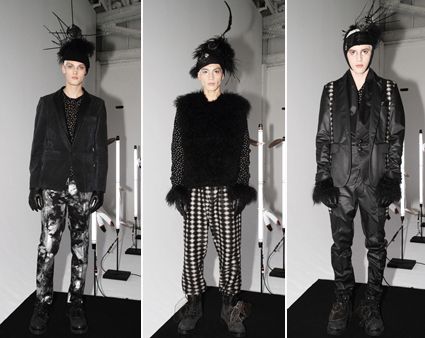

PETROU\MAN
The Central Saint Martin’s graduate has previously dabbled in womenswear as the creative director of Dennis Basso, as well as running his own line. But from the looks of his second menswear collection for Petrou\Man, Petrou is clearly going places with his offbeat, macabre visions. The designer combines elements of classic tailoring with sportswear fabrics and unconventional detailing. Citing the travels of nomads as the inspiration behind this season, Petrou played with various textures and patterns, including hand dyed tartan jackets, metallic suiting, feathered headpieces and trousers tie dyed in shades of black, white and blue. A jacket covered in over seven thousand safety pins is the perfect pick for Petrou’s modern day warrior on the move. (Styling: Robbie Spencer (Menswear Fashion Editor Dazed & Confused), hair: Duffy, makeup: Maki Ryoke, sets: Robert Sumrell, music: Michael Magnan, photos: Fumi Nagasaka)


ROBERT GELLER
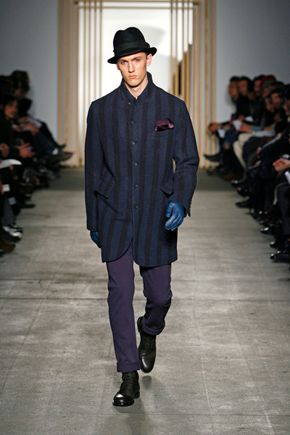
Downtown rock and roller met Upper East Side dandy at Robert Geller’s Autumn/Winter show. The CFDA award-winning German designer first stepped onto the fashion scene in 2002 with his cult label Cloak, and he hasn’t looked back since. Geller’s men stormed the runway to a roaring soundtrack of ‘70s rock outfitted in elegant wool capes, shredded black denim, slick leather jackets and the designer’s signature striped wool blazers and trousers. Luxurious touches were added with silk scarves and fur vests and shawls made from the wool of Japanese mountain goats. Always dark and romantic, Geller’s collection was fully realized and simply stunning.
---


SIKI IM
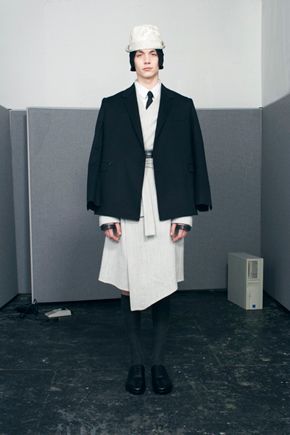
For his sophomore menswear presentation titled “New Era,” the Ecco Domani prizewinner and former senior designer of Helmut Lang cleverly arranged his models throughout a maze of trashed office cubicles, and included a live show by the band Sick Fix. This was not a typical day on Wall Street, and in our opinion Siki’s hand tailored menswear runs circles around the average businessman’s stodgy suiting. The collection featured sharp made to measure blazers, kimono-like overcoats and skirts in both knee and floor lengths. The clean looks were accessorized with leather straps, knee socks and knit scarves that transformed into sleeves. Hats constructed from newspaper were an appropriate finishing touch.
---


RAD HOURANI
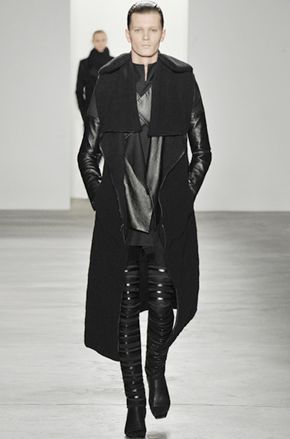
Rad Hourani continued his dark reign over New York Fashion Week with another bad to the bone runway show of androgynous models cloaked from head to toe in black. Inspired by the process of transformation, the self-taught Canadian designer created unisex pieces that could be worn in a multitude of ways. There were knit cardigans with detachable sleeves and rectangular leather jackets that transformed into capes, skirts and various other looks. One magical jacket could apparently be worn twelve different ways: an economical feat indeed. Other looks included patent leather pants and vests, jackets with attached backpacks, skintight strap covered leather pants— and zippers, zippers everywhere. The gothy black-clad audience salivated over each and every striking silhouette.
---


IN AISCE
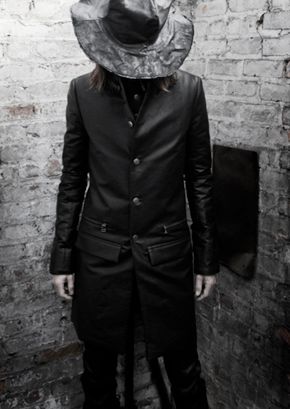
In Aisce (pronounced “in aska”) is a promising young label in its second season, created by Brooklyn based designer, Jona. A dichotomy between precision tailoring and rough, deconstructed garments, In Aisce is growing and developing into new territories. For his fall collection called Grey Heart Leaking, Jona decided to look to the arduous years of the American Civil War for reference. A classic 1800s cutaway style blazer was a beautiful standout piece, as well as a slim black tailored overcoat and an impeccably crafted hooded leather jacket. Other looks included a pair of white button fly overalls, elbow length shearling fingerless gloves and an intimidating wide brimmed leather hat.

---


ZERO + MARIA CORNEJO
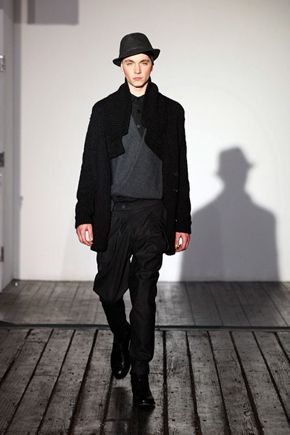
Cornejo’s androgynous female looks translate well into menswear, which she debuted last season. Always an exercise in architectural minimalism, the Chilean-born designer looked to “the darkness of Europe” for her Autumn/Winter collection. With a palette of charcoal gray, black and dark brown, Cornejo’s men were simple yet sophisticated in boxy wool overcoats, slouchy tapered trousers and fedoras. One model sported a comfy gray cape over brown leather jacket and pants, while another was outfitted in a black and white tartan jacket and hood combination. Very clean and very minimal, Cornejo’s vision is one we want to continue seeing.
---


ODYN VOVK
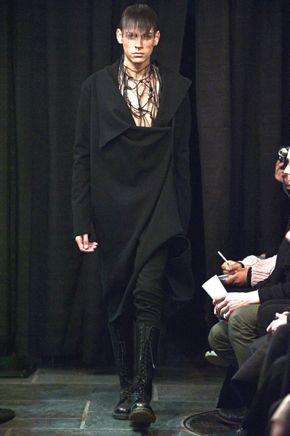
Austin Sherbanko of Odyn Vovk (Ukrainian for “one wolf”) offered an array of gothic garments with grungy appeal for his “Three Fold Path” collection. There were cropped distressed trousers, several black ribbed capes and a beautiful ochre-colored leather jacket with a diagonal zipper running from the shoulder to the waist. As usual, Sherbanko threw in several women’s looks for good measure —and despite sending a topless model down the runway last season— this time Sherbanko outfitted his lady in cropped fur jacket layered over a black hooded cape, and an asymmetrically cut and draped overcoat with origami-like folds. The feeling was dark and moody, and the cool kids were eating it all up.
---


YIGAL AZROUEL
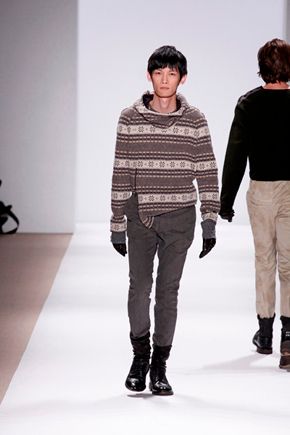
Yigal Azrouel has been steadily building his menswear repertoire in the last few seasons after first showing men’s clothing for Autumn/Winter 2007. The designer’s first look was a wool charcoal suit with black leather sleeves, soon followed by a model in slim black trousers and a leather tee with cotton sleeves. The designer continued this sleeve trend with a seemingly Rick Owens/Gareth Pugh inspired wool overcoat with attached metallic leather sleeves. Other looks included slim fitting leather jackets, a charcoal cardigan with offset buttons, turtlenecks and one very unfortunate looking pair of fair isle long johns with a cod piece fly that we could have done without.
---


PATRIK ERVELL
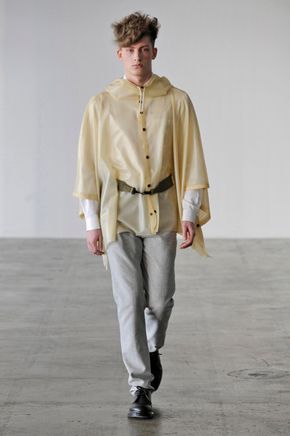
With a collection full of ponchos, macs and translucent raincoats, Patrik Ervell’s models were ready to take on some seriously stormy weather. The show opened with a cropped blue belted mac and slim gray trousers, followed by models with windswept hair outfitted in a translucent yellow rubber raincoats and slightly nerdy office get-ups. There were clean-cut suits in shades of navy and gray, backpacks, cropped jackets and lots of synthetic outerwear. Ervell’s minimalist, utilitarian aesthetic will likely serve him and his customers well in the new decade.
---


BILLY REID
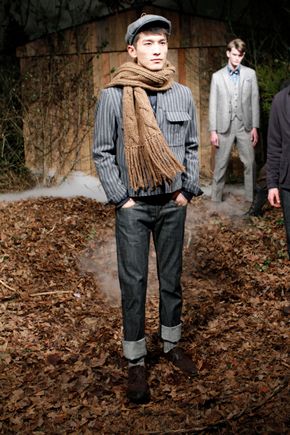
Southern dandy is what comes to mind when describing Billy Reid’s A/W 2010 collection. This year’s CFDA award winning designer presented clothing fit for country cousins and sophisticated urban dwellers alike. Models tramped through fog and leaves in a winter forest setting, outfitted in warm wooly knits, boxy jackets and plenty of plaid. The first model sported an oatmeal hued tweed suit, chambray button down and striped tie, while another model strolled by in a brown, black and red plaid suit and suspenders. Reid’s collection may not be breaking new ground, but its simple and comfortable and the guys want to wear it.
---


G-STAR
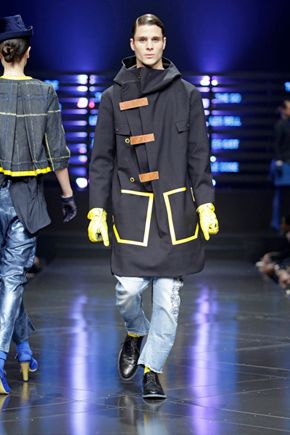
G-STAR’S extravagant runway show at the Hammerstein Ballroom was all about bright colors and exaggerated detailing. Large, hulking models stomped down the runway in neon yellow overcoats, rain jackets, vests, and of course, denim (though not as much as one would expect). One model wore tan baggy overalls paired with a chunky yellow knit turtleneck, while another sported patchwork jeans and a Big Bird-esque yellow cape. The bright yellow hues soon shifted into shades of neon blue and green, keeping up the brand’s extreme nature with large funnel necks, outlined pockets and metallic denim.
---


BESPOKEN
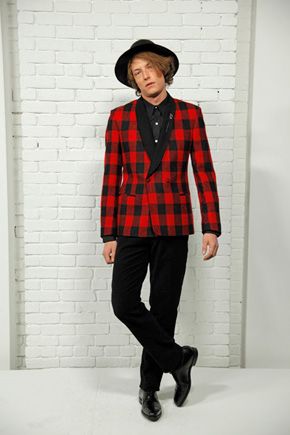
Originally inspired by the classic British clothier Turnbull and Asser, Bespoken adds a modern twist when creating its menswear collections —and there was definitely a British rocker vibe going on at the label’s A/W presentation. Models were dressed in slim fitting single-breasted jackets and trousers, a gray tweed vest and pants, a black corduroy jacket and accessories including bowties, suspenders and fedoras. A red and black buffalo plaid shawl collared blazer was a crowd pleaser, as well as a luxurious black leather jacket.
---

Wednesday, January 20, 2010

Wanted Magazine: Graham Tabor


“It’s always very important that whatever you’re working on feels modern, even if you’re working with an archaic technique,” remarks New York-based knitwear designer Graham Tabor. “Like macramé, for instance, which has been around for thousands of years. The challenge is how you’re able to take that technique and reinterpret it to make it exciting and new– and something that’s appropriate for now.”

There is a quality of organized chaos to Graham Tabor’s sophisticated designs. With his layers of deconstructed translucent fabrics, perforated wool knits, torn stitching and fantastically distorted facial masks made in collaboration with Kristen Barron, Tabor’s overall vision is an archetype of the primitive merging with the futuristic.

The designer has been developing his innovative tailoring techniques for the past ten years, and is currently making a name for himself as a forerunner in a skill that has remained largely untouched by American designers. “Knits are a very marketable commodity in New York,” says Tabor. “There aren’t a lot of people here who’re both technically skilled and have a good eye, and there’s very little production in the U.S.”

Born and bred outside of Detroit, Tabor later studied at Johns Hopkins and took several patternmaking classes at FIT before attending the Sorbonne in Paris for courses in photography. It was then that Tabor began to make an organic transition into the world of fashion design. “It actually happened almost by accident– I had all of these different interests, but I wasn’t necessarily really looking for a job in fashion. I was mostly trying to justify a reason for staying in Paris,” laughs Tabor. Clearly cut for the cloth, Tabor snagged an internship with Sébastien Menier, who is now the head of menswear at Maison Martin Margiela. The internship led to a knitwear design job under Melanie Ward at Karl Lagerfeld. “Lagerfeld was one of the best working experiences I’ve ever had,” comments Tabor. “It was a bit of a dream because it was so design lead. The team was very strong, and the product that we were doing was really amazing.”

Following his position at Lagerfeld, Tabor spent two years as the head of knitwear at Helmut Lang. Prada had just sold the company to Link Theory Holdings of Japan, and Tabor describes the challenging experience as “a bit mental.” But it was a challenge that prepared the designer for the launch of his own label. In 2008 Tabor was invited to show his debut eponymous collection in Paris at the annual Hyeres Festival of Fashion and Photography– the same event that has set the careers of Viktor and Rolf and photographer Sølve Sundsbø into motion. In addition to creating his own label, Tabor has consulted for TSE Cashmere, Rachel Roy and Camilla Staerk, and also styles photo shoots regularly for the likes of Qvest, Metal and Wad, among others.

Inspired by his natural surroundings as well as avant-garde Japanese designers Yohji Yamamoto and Rei Kawakubo of Comme des Garçons, Tabor cautions, “You always have to be careful to not be too directly inspired by someone, because then what is your voice?” With his body transforming creations and curiosity for the cutting-edge, Tabor’s voice is an escape to a brave new world of adventurous fashion: a black and white world of structural illusion and sexual ambiguity; and a world where apocalyptic drifters search for new life.

“I’m interested in the idea of how knowledge is transferred by certain groups in certain situations, and from one civilization to the next,” comments Tabor. “The knowledge that we have of the past is very fragmentary, and it’s through these bits and pieces that we try to bring together a story– and that’s what I find so interesting. Whenever I make a collection, I’m putting forth my own universe. And what I was trying to do was to put forth fragments of this universe, so the spectator can excavate and fill in the gaps with their own ideas and theories in order to make it their own.”

Also influenced by the work of American artist Gordon Matta-Clarke, Tabor's eyes light up when discussing the man’s unconventional processes. “One of the things he’s most known for are his excavations of abandoned buildings,” Tabor says. “He would cut out apertures in the ceiling and walls to allow light to come in. By removing these pieces and revealing many different dimensions at once, he was able to completely transform how your brain experienced the space.”

Adapting and expanding upon Matta-Clarke’s architectural techniques, Tabor uses his intricate stitch work, cut-outs, and various sheer fabrics to manipulate one’s perception of his own line of garments. “Part of the whole understanding for the collection was the idea of opening up this transparency,” he says. “Not necessarily actually revealing the body or the garment, but transforming it. These transparencies alter the texture of the skin and add to and change the dimension of the body, so it’s as if the transparency has been negated.” In shades of ivory and black, Tabor’s paper-thin trousers, seamless translucent jackets, and gash-filled knits play with the silhouette of each wearer. The garments drape and unravel around the body, forming a complex sort of camouflage for the new millennium.

What’s up next for this talented young designer? In a joint effort with photographer Miguel Villalobos (a regular contributor to Jalouse, Fantastic Man, Metal and more), Tabor’s latest project, titled 1 – 100, is a seasonless collection of uniquely handcrafted one-off cuffs, bracelets and headpieces. Each unisex collection of accessories will focus on a different material and artesian technique, the first being leather molded and dyed by hand. Sold in numbered editions of 100 pieces, 1 – 100 is currently available in Japan— though Tabor and Villalobos plan to enter the European market very soon.

While his conceptual fashions are currently available through private order only, Tabor has been working with Woolmark and Australian Wool Innovation to develop some more commercial pieces to add to his line. “Creating unconventional clothing can be a bit self-limiting because it can be too extreme for consumers,” says Tabor, “But I still want to make something that people are excited about.”

Written by Carolyn Brennan

Photos courtesy of Migue Villalobos, www.miguelvillalobos.net

Wanted Magazine: Damir Doma Interview


From the premiere issue of Wanted Magazine: http://www.awantedmag.com/Issue-1/damirdoma.html

Damir Doma is a young Croatian-born menswear designer in the prime stages of his career. He grew up in Germany, studied fashion at Esmod in Munich and Berlin and is currently based in the fashion capital of Paris. Doma’s creations are unlike most options available to men today, and the 28-year-old Raf Simons protégé has already been compared to gothic greats like Rick Owens and Ann Demeulemeester. After his debut collection, Damir Doma quickly became a name to watch in the menswear industry– however fickle it may be. While greatly inspired by his natural surroundings, Doma is also a purveyor of art, and counts significant 20th century German artists Anselm Kiefer, Joseph Beuys and Gerhard Richter as important influences in his creative design process. A perfectionist who values originality in every dimension, Doma is known to even compose the music played during his own runway shows.

Doma’s Autumn/Winter 2009-2010 collection featured pale-faced models swathed in layers of beautifully draped fabric, heavy wool coats, leggings and asymmetrically cut jackets with rounded or sloping shoulders. An abundance of looks came in winter white, though Doma didn’t forget to include various shades of grey and his favorite, jet black. There were zip-front jumpsuits and boots, full trousers with tapered ankles, head wraps and lots of braided detailing.

The designer’s latest collection for Spring/Summer 2010 was shown at the Palais de Tokyo in Paris this June. His new looks expand upon the ideas and silhouettes formed in the previous season: oversized shapes, multi-layered fabrics and thought-out androgynous appeal. The collection has a much more natural pallet of earth tones, with neutral shades of beige, cream, and ivory– although the most surprising aspect this season is a multitude of eye-popping blood red pieces. With slicked-back hair and stern gazes, the models were outfitted in sheer tanks, oversized linen tunics and trousers, crisp white jackets and sheer harem shorts paired with sturdy boots or strappy Jesus sandals. Doma paid great detail to the varying textures and movement of the fabric, making the collection one of his strongest yet.

WANTED: How did you first become interested in fashion?

DAMIR DOMA: Fashion was all around me when I was growing up. My mother is a fashion designer as well. My sister and I were always playing with her fabrics, and at an early age we started to create our own things. My first contact with a well-known fashion designer was when I was about 14 or 15 years old. I grew up in a little city in the South of Germany, so it was quite hard to buy fashion clothes. There was and still is one tiny fashion boutique called “Altra Moda.” That’s the shop where I bought my first Helmut Lang pieces! I used to be a big fan of Helmut– I think it’s really sad that he stopped designing.

W: What was it like growing up in Germany?

DD: My childhood was really amazing. I was very lucky growing up in South Germany, just in front of the Alps-- between the lakes and the mountains. I spent most of my time outside, playing sports and exploring the nature.

W: What made you decide to start designing your own label?

DD: My personality is one that needs to create new things. I believe that it’s my destiny to create and it actually doesn’t matter so much if it is fashion or anything else. I need to merge myself into my work and I always wanted to create my own universe and to express myself.

W:
Can you tell me what it was like to show your collection at Modniy Desant in St. Petersburg?

DD: Modniy Desant was an exiting experience for me and also for my whole team. It was my first time in Russia. As I’m originally coming from a Socialistic country, I had some kind of image in mind before entering Russia. At the border we immediately had the pleasure to meet the Russian custom officers. That was shocking. I remember I thought that we would never enter Russia with the full collection! Besides some initial difficulties, the trip was nice. We did a beautiful show and I met Frol [Burimskiy], who is now part of my team. He moved from St. Petersburg to Paris, and is the responsible for our Paris Damir Doma boutique.

W:W: What was the purpose behind your Viel video collaboration with Alessandro Tinelli?

DD: When it comes to art, most of the time the process is the purpose. I met Alessandro during my first visit to Tokyo in 2007. Alessandro is an Italian artist who moved to Japan a few years ago. Masahiro Tsunoda from Lift introduced us to each other. In the last two years we’ve done so many things together. Alessandro’s specialties are video, video post-production and music. Viel is the video/music form of Damir Doma. We tried to explain my universe through different “eyes.”

W: Your Identity project shows how influenced you are by nature– can you discuss how the great outdoors has shaped your character as well as your collections?

DD: First of all, I believe that it’s crucial that my personality and my collection is 100% as “one.” As I mentioned earlier, I grew up with nature all around me, and I believe that a big part of my aesthetics developed in my early years. I love natural materials and colors– but my concept goes much further. I believe that clothing and body have to be a unity– clothing shouldn’t fight against the shape of the body. Clothing needs to respect the individual’s identity. A masquerade is not an option for me. I’m a very respectful, calm and sensitive person– and that’s what you'll find in my clothing. They are subtle and profound. My collections need to be explored and well understood.

W: What was it like to work for your mentor Raf Simons?

DD: Raf has a great personality. I remember that I was overwhelmed at the beginning. When I was at fashion school I looked up to him. Raf showed me a new perspective on fashion and a new way of working. At the end, it’s hard to recognize his influence on my work, as we don’t share the same aesthetics, but I adopted some of his concepts.

W: What other designers are you influenced or inspired by?

DD: As I mentioned at the beginning, I loved Helmut Lang and I also like Jil Sander. I adore the early work of Issey Miyake.

W: You also worked for Dirk Schoenberger– what was that experience like?

DD: Working with and for Dirk was more difficult for me, as we were never able to find a common denominator. At that time, Dirk was part of the BVBA 32 [a Belgian collective that produces high quality designer goods]. I believe that from a business point-of-view, I learned a lot during that period. I learned how to structure a good collection, and I learned to be focused.

W: You referenced the German painter/sculptor Anselm Kiefer as an inspiration behind your latest collection for A/W ’09-‘10– can you explain why?

DD: Anselm Kiefer did a fantastic exhibition in the Grand Palais two years ago. I love Kiefer’s images, haptics and structures. I imagined the models walking through the deserts of stone towers, which he built up. In his work, nature conquers the human creation, and I think that’s an amazing idea.

W: I got a bit of a post-apocalyptic Star Wars vibe from this collection– I could see Luke Skywalker wearing a lot of these looks– is that something you thought about?

DD: I’m not a big Star Wars fan, but I can see the connection. In particular, you are probably thinking of the priests in the movie. I like the idea of spirituality!

W: What are your favorite fabrics to work with?

DD: I work with all kinds of natural materials. It really depends on the product, but in general, linen is my favorite material. Linen has some kind of life of it’s own– you have to treat it with respect.

W: How do you pick the haunting music for your shows?

DD: For a while we have been composing the music especially for the shows. I decided this way works better for me, because I don’t want to give any references. The music goes hand in hand with the clothing, the materials and the colors. I’m a creator. The fashion show is giving an idea of the future and I believe that it’s wrong to use music that already exists.

W: You recently opened your flagship store in Paris – can you describe the experience?

DD: The store is our little baby. We take good care of it and we’re trying to raise it at the moment. We want it to be an amazing and cool adult!

W: What are your plans for the future of your label?

DD: We want to keep the label very exclusive. In the future we are planning to expand the Damir Doma universe with new products. I’m working on some very secret stuff right now. I also want to come up with a women’s line quite soon.

W: What are your other interests besides fashion?

DD: I love the arts. Every season I try to collaborate with a young artist to create other projects next to the collection.

Damir Doma’s designs are available in the U.S. at Atelier New York, Sartorial Loft and H. Lorenzo in Los Angeles, and Mixmix in Honolulu and Waikiki.

Written by Carolyn Brennan
Photo courtesy of Damir Doma and Etienne Tordoir